
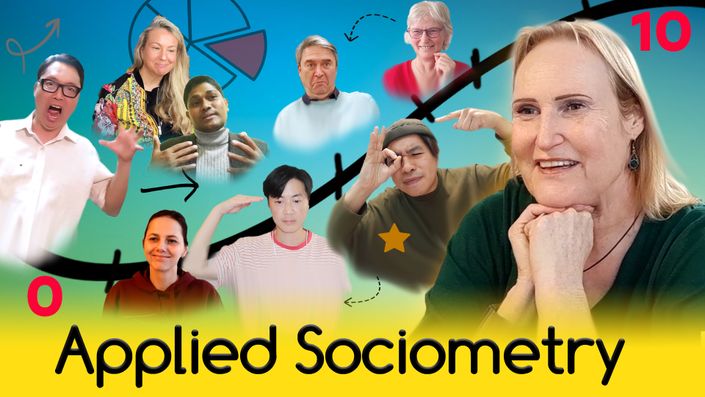
Applied Sociometry. Module 2: Double Phase/Mirror Phase
Double Phase and Mirror Phase are integral concepts in sociometry, providing insights into the intricacies of social interactions and individual self-perception within a group context. Sociometry is a tool applied across various fields to enhance understanding of social dynamics, improve group functioning, and design effective interventions. Its practical applications help address social issues, improve relationships, and foster a supportive and cohesive environment in educational, organizational, therapeutic, and community settings. Course led by expert Jacomien Ilbrink-de Visser from the Netherlands, CP, PAT (TEP in training).
Residence countries are grouped into Bands A–D, offering 30–70% off all modules and courses. Find your band here.
About the Course:
Sociometry is a quantitative method for measuring social relationships. Developed by Jacob L. Moreno, it involves analyzing the patterns and structures of social interactions within a group. Sociometry aims to uncover the underlying social connections, such as friendships, alliances, and conflicts, by mapping out the preferences and choices individuals make regarding their relationships with others. This approach is often used in psychology, sociology, and organizational studies to improve group dynamics, enhance communication, and resolve conflicts.
Double Phase helps individuals understand their social connections and identify shared experiences, fostering deeper group cohesion. Mirror Phase allows participants to see themselves from others' perspectives, promoting self-awareness and empathy. By integrating these concepts into their practice, professionals can facilitate more impactful interventions and support personal growth within groups. Join an exciting transformative journey with 9 professionals—therapists, counselors, and coaches—from the US, Netherlands, Spain, Nepal, Latvia, Hong Kong, and Malaysia. Guided by instructor Jacomien Ilbrink-de Visser, CP, PAT (TEP in training).
This module is designed for:
• Therapists
• Social workers
• Counselors
• Educators
• Coaches
• Community leaders
• Researchers
• Criminal justice officers
Appropriate for those who are new to action methods, as well as experienced practitioners, students in mental health fields, and those who want to develop their skills in action methods.
Learning Objectives:
• Demonstrate How to Enhance Self-Awareness and Empathy among group members: utilize the Mirror Phase concept to show each group member how group participants are perceived by others, thereby increasing their self-awareness and empathy towards group members.
• Demonstrate How to Strengthen Group Cohesion and Connection: through the double phase concept, show how to explore and identify shared experiences and connections within the group, leading to stronger group cohesion and a more profound sense of community.
Module highlights:
• Core Techniques: Dyads, Locograms, Spectrograms, Sociograms
• Facilitation Skills: module demonstrates how to facilitate a group, using Sociometric instruments.
• Dynamic Learning: Engage with dynamic video content, enhancing the learning experience through diverse perspectives.
• Knowledge Assessment: Assess your grasp of Sociometry with a test, followed by a brief survey to provide feedback, solidifying your proficiency in the methodology.
How and where to use:
In Education, for:
• Classroom Dynamics
• Bullying Prevention
• Conflict management
• Building relationship
In Organizational Development, for:
• Team Building
• Change Management
• Conflict resolution
In Therapy and Counseling, for:
• Group Therapy
• Couples and Family Therapy
• Substance Use Counseling
In Community Development, for:
• Community Building
• Conflict Resolution
In Health and Social Services, for:
• Patient Care
• Social Work
In Research, for:
• Social Science Research
In Criminal Justice, for:
• Rehabilitation Programs
• Gang Dynamics
Presenter:
Jacomien Ilbrink-de Visser from the Netherlands, CP, PAT (TEP in training). Jacomien received her training in psychodrama in New York City, where she mastered the application of explicit sociometry, also known as hand-on-shoulders sociometry. Over the past decade, she has specialized in teaching sociometry to clinicians, coaches, and educators in Europe, developing a structured approach to its safe application using Moreno’s developmental theory as a guideline.
Module Includes:
Main Content:
• Videos - 97 min
• Test - 30 min
• Course Survey - 5 min
Recommended Content:
• Practicum - 60 min
Hours for Certificate:
• 3.5 training hours on the Action Explorations Education Certificate. Our courses may be applied toward professional certification/training hours, depending on your board’s policies. Please verify eligibility with your certifying board or primary trainer. We’re happy to connect and answer questions about course content, hours, and documentation. Reach out anytime with your questions.
Module Curriculum
*Recommended Videos Not Included in Total Hours for Certificate
- Video 1. Check in Spectrograms. Strengths. (12:45 min)
- Video 2. Strengths Spectrogram. Teaching Points. (14:32 min)
- Video 3. Concretizing Strengths with Objects (6:41 min)
- Video 4. Learning Style Locogram (10:36 min)
- Video 5. Sculptures of Learning Styles. (11:01 min)
- Video 6. Similarities Action Sociogram. (15:10 min)
- Video 7. Action Sociogram. Reverse Sociometry. (14:29 min)
- Video 8. Teaching Points. Sharing. (11:42 min)
What Students Are Saying ⭐
Real reviews from students who have taken this course.