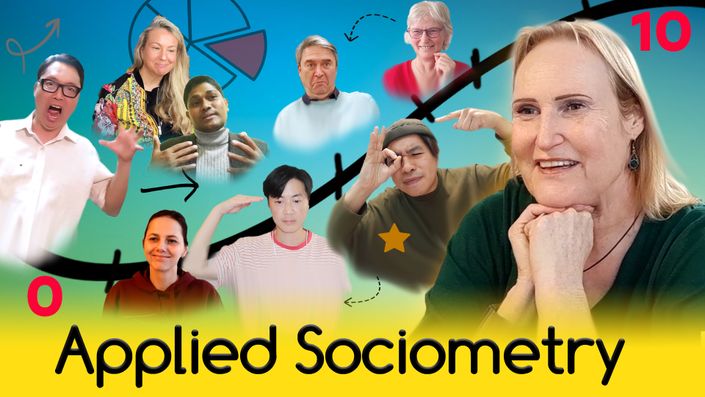
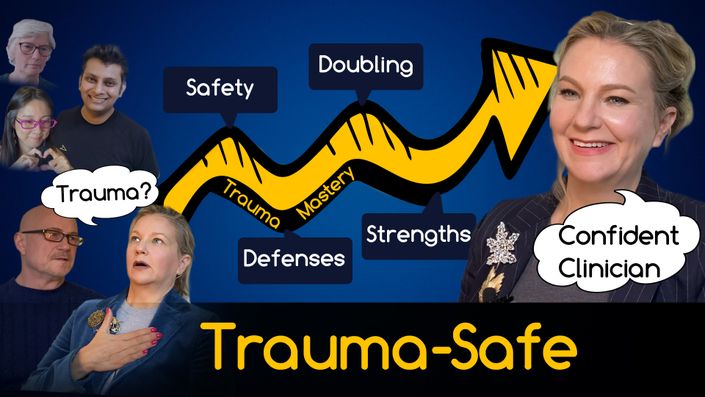
Applied Sociometry. Module 4: Role Reversal
By exploring role and role development concepts in sociometry, practitioners can create more effective and supportive group environments. Course led by expert Jacomien Ilbrink-de Visser from the Netherlands, CP, PAT (TEP in training)
$60 (One Module) - 100 days access
Countries of resedence are grouped into pricing Bands A–D, offering 30–70% discounts, applied to all modules and courses. Find your band here.
About the Course:
Sociometry is a quantitative method for measuring social relationships. Developed by Jacob L. Moreno, it involves analyzing the patterns and structures of social interactions within a group. Sociometry aims to uncover the underlying social connections, such as friendships, alliances, and conflicts, by mapping out the preferences and choices individuals make regarding their relationships with others. This approach is often used in psychology, sociology, and organizational studies to improve group dynamics, enhance communication, and resolve conflicts.
Role Reversal is a powerful technique where two individuals switch roles to step into each other's perspectives. This method helps participants to gain a deeper understanding of the thoughts, emotions, and experiences of others within the group. By embodying someone else's role, individuals can develop empathy, resolve conflicts, and enhance interpersonal relationships. This technique is widely used in therapeutic settings to facilitate insight and promote emotional healing.
Join an exciting transformative journey with 9 professionals—therapists, counselors, and coaches—from the US, Netherlands, Spain, Nepal, Latvia, Hong Kong, and Malaysia. Guided by instructor Jacomien Ilbrink-de Visser, CP, PAT (TEP in training).
This module is designed for:
• Therapists
• Social workers
• Counselors
• Educators
• Coaches
• Community leaders
• Researchers
• Criminal justice officers
• New to action methods
• Experienced practitioners seeking to expand their skillset
• Students in mental health fields
• Professionals interested in applying sociometry techniques in their work.
Appropriate for those who are new to action methods, as well as experienced practitioners, students in mental health fields, and those who want to develop their skills in action methods.
Learning Objectives:
• Demonstrate the development of insight and empathy through Role Reversal and Doubling, enhancing interpersonal relationships
• Illustrate the use of key sociometric techniques to strengthen group cohesion and improve communication
How and where to use:
In Education, for:
• Classroom Dynamics
• Bullying Prevention
• Conflict management
• Building relationship
In Organizational Development, for:
• Team Building
• Change Management
• Conflict resolution
In Therapy and Counseling, for:
• Group Therapy
• Couples and Family Therapy
• Substance Use Counseling
In Community Development, for:
• Community Building
• Conflict Resolution
In Health and Social Services, for:
• Patient Care
• Social Work
In Research, for:
• Social Science Research
In Criminal Justice, for:
• Rehabilitation Programs
• Gang Dynamics
Module highlights:
• Key Sociometric concepts: action sociograms, spectrograms, dyads, doubling, role reversal
• Facilitation Skills: successfully include individuals who struggle to engage in groups (isolates). Utilize “Role atom” chart, the visual tool that helps to map out the different roles participants play in life and want to change.
Presenter:
Jacomien Ilbrink-de Visser from the Netherlands, CP, PAT (TEP in training). Jacomien received her training in psychodrama in New York City, where she mastered the application of explicit sociometry, also known as hand-on-shoulders sociometry. Over the past decade, she has specialized in teaching sociometry to clinicians, coaches, and educators in Europe, developing a structured approach to its safe application using Moreno’s developmental theory as a guideline.
Module Includes:
Main Content:
• Videos - 91 min
• Handouts - 10 min
• Test - 30 min
• Course Survey - 5 min
Recommended Content:
• Practicum - 60 min
Hours for Certificate:
• 3.5 training hours on the Action Explorations Education Certificate. Our courses may be applied toward professional certification/training hours, depending on your board’s policies. Please verify eligibility with your certifying board or primary trainer. We’re happy to connect and answer questions about course content, hours, and documentation. Reach out anytime with your questions.
Module Curriculum
Recommended Videos Not Included in Total Hours for Certificate
- Video 1. Warm Up. Getting to Know Each Other. (13:22 min)
- Video 2. Action Sociogram: Safe Roles (True Sociometry) (10:54 min)
- Video 3. Role Atom. Self-Care Spectrogram. (10:55 min)
- Video 4. Role Charts. Dyads. (22:04 min)
- Video 5. Action Sociograms: Criteria for Creating Doubles and Binding Outsiders in the Groups. (12:20 min)
- Video 6. Action Sociogram Practice. (21:44 min)